


Why is Backdrilling Crucial for Signal Integrity in high-speed PCB design
 30 Jan 2026 17:19:24 GMT
Tyson From www.hycxpcba.com
30 Jan 2026 17:19:24 GMT
Tyson From www.hycxpcba.com
Backdrilling is vital for maintaining signal integrity in high-speed PCB designs.
Without it, unwanted portions of vias—referred to as stubs—can cause several issues that affect the quality of the signal.
These issues include signal reflections, interference, waveform distortion, and even bandwidth limitations.
Signal Reflection Problems: How Does It Affect Signal Quality?
Signal reflections occur when there is unused copper in a via.
When a signal travels through a via, only the portion of the via that is part of the signal path should be involved in the transmission.
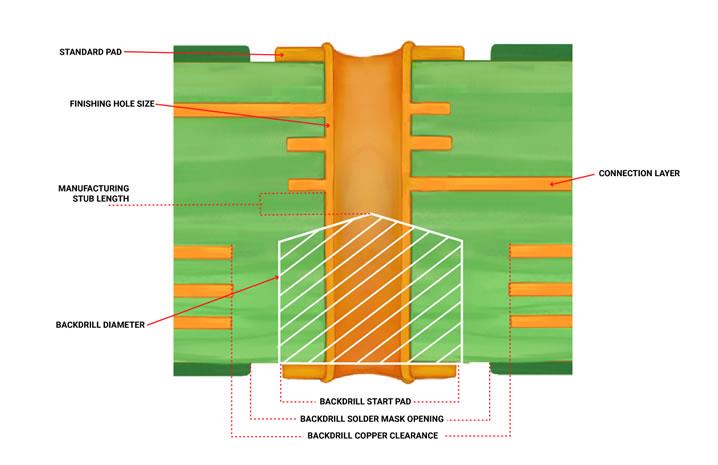
If there is extra copper, called a stub, it can act like an open-ended wire.
This stub reflects some of the signal back toward the source, causing signal reflections.
These reflections distort the original signal and can interfere with the clear transmission of data.
Effects on Time and Frequency Domains:
Time Domain: Reflections cause ringing and overshoot in the signal.
This means that the signal doesn’t just go to its intended destination—it bounces back and creates echoes that can confuse the receiving system.
Frequency Domain: The signal’s frequency response is also affected.
Reflections create impedance mismatches, leading to signal loss at certain frequencies, resulting in deep dips in the signal's frequency spectrum.
For example, in a high-speed data transfer, such as a 10Gbps Ethernet connection,
even small reflections can lead to timing errors or lost data packets, significantly slowing down the system.

Interference and Waveform Distortion
Reflected signals distort the waveform and cause overshoot.
The reflections from the stub interact with the original signal, causing a phenomenon called waveform distortion.
This happens when the reflected signal combines with the forward signal, altering its shape.
Overshoot occurs when the signal spikes beyond its normal range, while ringing occurs when the signal oscillates before settling at its final value.
Impact on Eye Diagrams: Eye diagrams are used to visualize the quality of digital signals.
Reflections cause the signal to degrade, leading to a closed eye pattern, which indicates poor signal quality. This results in the loss of data.
Impact on Bit Error Rate (BER): Distorted signals increase the bit error rate—the number of incorrect bits received compared to total bits transmitted.
A higher BER leads to more frequent communication errors and lower system reliability.
A practical example is in DDR (Double Data Rate) memory used in computers.
If the signal reflection is significant, the memory controller might misinterpret data, causing errors in data storage or retrieval.
This can significantly slow down system performance and cause crashes.
Bandwidth Limitations
Stubs can reduce the bandwidth of a signal, especially at higher frequencies.
The length of the stub influences its resonance frequency—the frequency at which it naturally vibrates.
When a signal’s frequency approaches this resonance, the stub starts absorbing the signal, resulting in signal attenuation (reduced signal strength). The longer the stub, the lower the resonance frequency, which leads to more pronounced attenuation at higher frequencies.
High-frequency signals like those used in PCIe (Peripheral Component Interconnect Express)
or DDR memory are especially susceptible to this problem. These signals rely on very high frequencies for fast data transmission.
If a stub is too long, it can cause signal loss, making the system slower or even causing communication failure.
For instance, a PCIe signal running at 16GT/s (gigatransfers per second) could suffer significant degradation
if the stub within the via is not removed via backdrilling. The signal might not reach its destination in time, causing errors or delays.
Impact on Bandwidth:
Reduced Effective Bandwidth: When stubs absorb parts of the signal,
the effective bandwidth decreases because the system cannot transmit data efficiently at high speeds.
System Performance: In high-speed data protocols, such as PCIe or DDR,
the bandwidth limitations introduced by stubs can result in poor system performance, causing bottlenecks or failures in data processing.
Negative Effects of Stubs
In high-speed PCB design, stubs (the unused portions of vias) can have several negative impacts on signal integrity.
These issues include signal reflection, increased insertion loss, crosstalk, and timing problems, all of which degrade the performance of the system.
Signal Reflection and Impedance Mismatch
Stubs act as sources of signal reflection.
When a signal travels through a via, it is intended to pass through the via and continue to the next layer without interference.
However, if there is unused copper, forming a stub, this portion can reflect part of the signal back toward the source.
This phenomenon is called signal reflection. The reflected signal interferes with the original signal, causing distortions such as overshoot, ringing, and incorrect signal timing.
Effect on Differential Signals:
Differential signals, which use two complementary paths for transmission, are especially sensitive to reflections.
A stub can cause mode conversion, where the desired differential signal turns into unwanted common-mode noise. This noise can significantly affect the quality of the signal, especially in high-speed digital circuits.
For example, in a DDR memory system, reflections caused by stubs can cause errors in reading or writing data,
leading to slowdowns and system instability. In high-frequency systems like PCIe, this signal disruption could result in data loss, reducing the performance of the entire communication channel.
Increased Insertion Loss and Crosstalk
Stubs increase insertion loss.
Insertion loss refers to the loss of signal strength as it travels through the transmission path.
Stubs increase insertion loss by absorbing energy from the signal at certain frequencies, which reduces the overall power reaching the destination.
The longer the stub, the more energy it absorbs, leading to more significant signal attenuation.
Example: In a high-speed Ethernet connection, even a small amount of signal loss can lead to slower data transmission or complete communication failure.
Stubs contribute to crosstalk.
Crosstalk occurs when signals from adjacent transmission paths interfere with each other. Stubs act as unwanted conductors
that can create parasitic capacitance and inductance between nearby signal traces.
This parasitic coupling can cause signals to leak from one path to another, creating interference that degrades signal quality.
In modern communication systems, such as USB or HDMI, crosstalk can severely affect the data integrity of high-speed signals,
leading to errors, noise, and slower data rates. By removing stubs through backdrilling, these interference issues are minimized.
Timing Issues: Signal Transmission Timing Disruptions
Reflections and ringing introduce timing jitter.
When signals are reflected back due to stubs, they cause ringing—oscillations that occur after the signal has passed its peak.
This results in timing jitter, where the timing of the signal’s edges (the transitions between high and low states) becomes uncertain.
Jitter is problematic in high-precision systems because it reduces the available timing margin for correctly interpreting the signal.
Impact on High-Precision Timing Systems:
Timing is crucial in systems like clock signals or high-speed serial data transmission.
Even small amounts of jitter can lead to misinterpretation of the signal, causing data corruption, errors, or even system failure.
Example: In high-performance computing or telecommunications systems, where clock signals synchronize multiple components,
jitter can cause significant issues. If the timing isn’t precise, components may operate out of sync, leading to data loss or malfunction.
The effect of stubs on jitter is especially critical for high-speed serial links like PCIe 4.0 or Thunderbolt,
where even tiny timing deviations can lead to severe system instability.
How Does Backdrilling Solve These Problems?
Backdrilling is a critical technique in high-speed PCB design that helps resolve various signal integrity issues, such as reflections,
signal distortion, and timing problems. By removing unwanted copper from vias (the holes connecting different layers of the PCB),
backdrilling enhances signal transmission and ensures high-quality performance, especially in high-speed applications.
The Role of Backdrilling in High-Speed Signal Transmission
How does backdrilling reduce reflections and signal distortion?
Backdrilling plays a vital role in reducing signal reflections and signal distortion caused by stubs.
When there is unused copper in a via (the stub), it reflects part of the signal, which distorts the waveform and introduces errors.
Backdrilling removes this excess copper, effectively eliminating the stub and preventing reflections.
This results in a cleaner signal, which is crucial for high-speed data transmission.
Example: In PCIe or DDR memory applications, backdrilling ensures that the high-speed signals can travel through the PCB
without interference from reflections, allowing for faster and more reliable data transfer.
How does backdrilling shorten stub length and improve signal integrity?
The key to improving signal integrity is reducing the length of the stub. The longer the stub, the greater the potential for it to act as an antenna,
causing signal degradation. By backdrilling, the excess copper is removed, effectively shortening the stub length.
This makes the signal path more direct and reduces the likelihood of signal loss or distortion.
Impact on Signal Integrity: A shorter stub means less chance for unwanted resonance or impedance mismatches,
improving the signal's overall quality. This is especially important in high-frequency systems,
where even small imperfections can significantly affect performance.
Real-World Example: Consider a high-speed USB 3.0 connection. Backdrilling ensures that the signal travels smoothly with minimal loss or distortion,
allowing for faster data rates and more reliable device connections.
The Precision Requirements and Challenges of Backdrilling
How does the precision of backdrilling affect signal integrity?
Precision is crucial when performing backdrilling. If the drilling is not done accurately, there is a risk of damaging the signal path or failing to remove enough of the stub.
This can negatively impact signal integrity, leading to issues such as reflections, impedance mismatches, or even complete signal failure.
Therefore, backdrilling must be performed with high accuracy to avoid such problems.
Example: In advanced PCBs used for 5G communication systems, even minor imperfections caused by imprecise backdrilling can result in high-frequency signal degradation,
reducing the overall performance of the system.
How is the depth and position of backdrilling controlled to avoid damaging the signal path?
Controlling the depth and position of the backdrill is critical. The goal is to remove only the unused copper without touching the parts of the via that are part of the active signal path.
This requires specialized equipment and precise control to ensure that the drill stops at the exact right point. If the depth is too shallow,
some of the stub may remain, and if it's too deep, the signal path could be damaged.
Step-by-Step Precision Control: Modern backdrilling machines use advanced sensors and software to monitor the drilling process in real-time.
This ensures that the drill reaches the correct depth and position. The depth is usually measured in microns (thousandths of a millimeter), making it a highly precise operation.
-
06 Mar 2026 14:08:44 GMT
What is Heavy Copper PCB
-
04 Mar 2026 10:15:22 GMT
How Dose AOI Enhances Solder Paste Inspection For PCB